What is SEO and is it important? The answer to the second part of that question is YES, it is definitely important. SEO stands for Search Engine Optimization and really is just a way of making certain that the Search Engines (your browser’s programming) like Google understand what you are writing about. This is very important to both you and the Search Engines.
This post may contain some affiliate links for your convenience (which means if you make a purchase after clicking a link I may earn a small commission but it won’t cost you a penny more)! You will find my full disclosure policy here.
Why is SEO important?
Why is SEO important to your website? SEO is the key to ensuring that your website and posts appear when people search for a specific topic. We will use Google as an example. Say someone is searching for a recipe for chocolate cake or the quickest way to clean something. They will type in their question and Google will search through its knowledge base and locate the information that best matches what they are searching for. Google’s goal is to create the best user experience possible and will display what it believes that user is looking for.
Your post needs to provide the clearest information possible to Google for it to be displayed to that user. The alternative? It might end up on page 32 and people rarely click to page 32 to find their answers. I don’t know about you however I rarely go past page one when I am searching for answers.
Keywords and their role in SEO
Keywords have an important role in ensuring Google understands what you are writing about. There are many ways to locate keywords that will help Google understand. One super-easy way is to go look at Google itself.
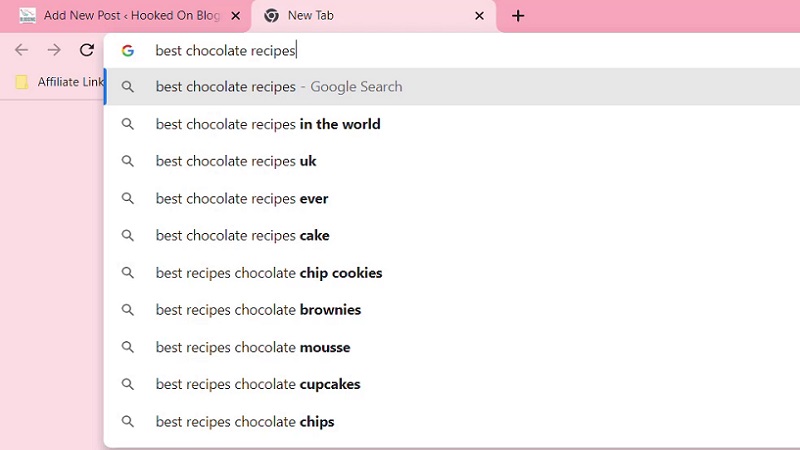
Yep, Google will help you find keywords based on what it knows people have searched for previously. See the example below when searching for the best chocolate recipes. Google offers you a LOT of suggestions to help you, the user, to find what you are looking for. It bases this on popular search terms.
Types of Keywords
There are basically two types of Keywords. A single Keyword and then there are what are referred to as “Long-Tail Keywords“. The single word is self-explanatory so that is pretty clear. The Long-Tail Keywords are what can be seen in the picture above. Each one of Google’s suggestions shown in the picture above is a Long-Tail Keyword.
Keywords Everywhere
There are many factors to choosing the correct keywords and many Keyword tools to choose from. I use a couple of methods.
The Keywords Everywhere tool is one that I really like to help me find various Keywords and search term volumes that I am looking for. You can install Keywords Everywhere for FREE into your browser.
Note that Keywords Everywhere is what is termed a freemium tool –
– Free users have access to all our features (keyword widgets, trend charts, traffic data, YouTube metrics etc) other than search volume data.
– Only paid users can see the volume, CPC, competition & trend data. You need to purchase credits for this data – https://keywordseverywhere.com/credits.html
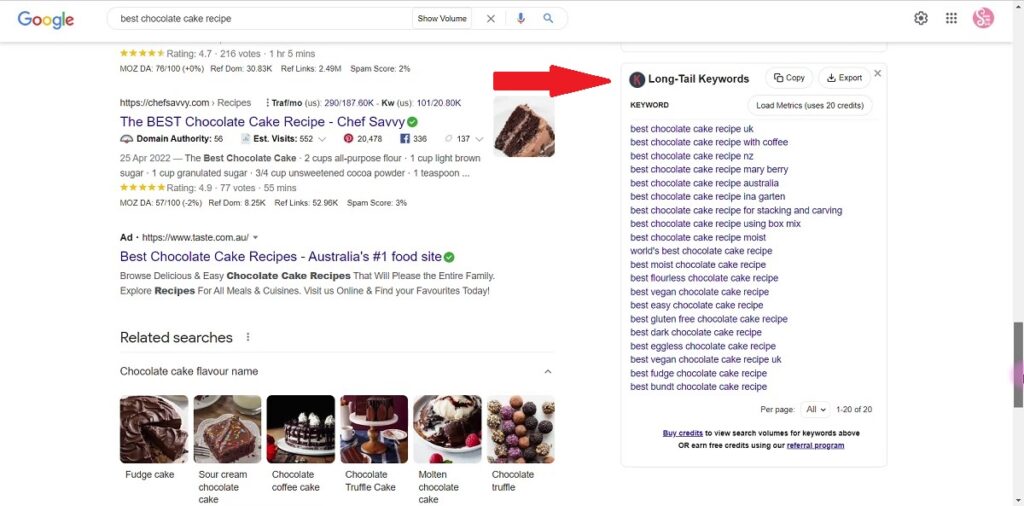
In my Google view, I can find the Long-Tail Keywords about halfway down the page. Look at the BIG list of Long-Tail Keywords found for Chocolate Cake recipes.
More to Keywords than just wording
While looking at what Long-Tail Keywords search terms is a great start, there is so much more to SEO so that your post will rank well on Google.
The next thing we might look at is metrics. Metrics will indicate the volume that which a particular search term is being searched. You also need to keep in mind what websites are ranking for a particular search term. Let’s face it if you are just starting out, it can be a bit daunting to try and rank against the big boys/girls. Ideally, I aim for a middle of the road approach however some bloggers aim for lower metrics.
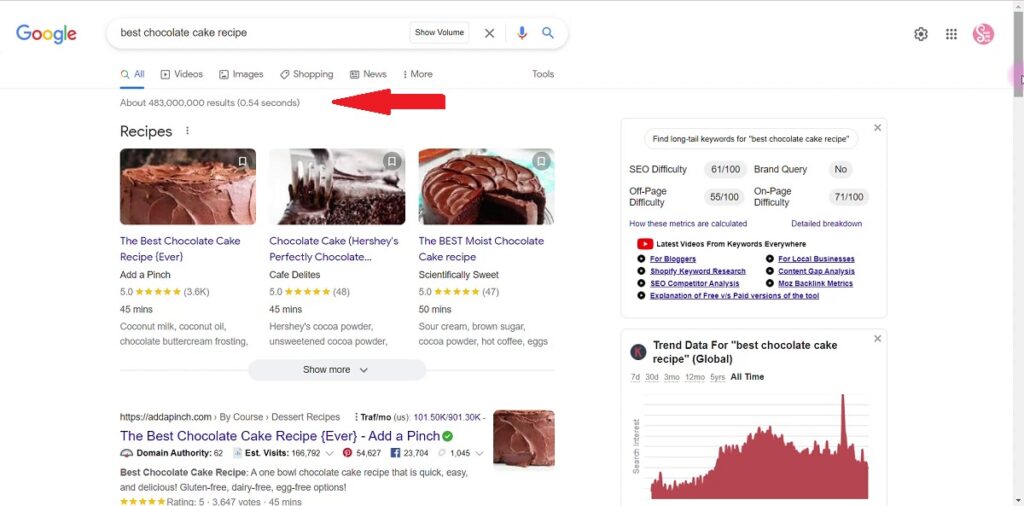
The picture below shows the Metrics of a particular Long-Tailed Keyword underneath the search bar. 483,000,000 results is a little higher than I would use as it would be quite difficult to rank on page 1 with it. This does not mean that I would not include the search term in my post somewhere, just not as the main Long-Tail Keyword. Usually, as you are writing, more than one Keyword term will occur quite naturally if you are staying on topic.
This is a good thing.
More Keyword clues on Google
Google can be so handy in helping you with choosing your Keywords. As you look through the search page results you will see a number of areas to assist you with ideas.
Below is the “People also ask” section. I love this section, both when writing my blog posts AND when searching for answers. Others are often looking for similar answers to what I am looking for. Bonus!
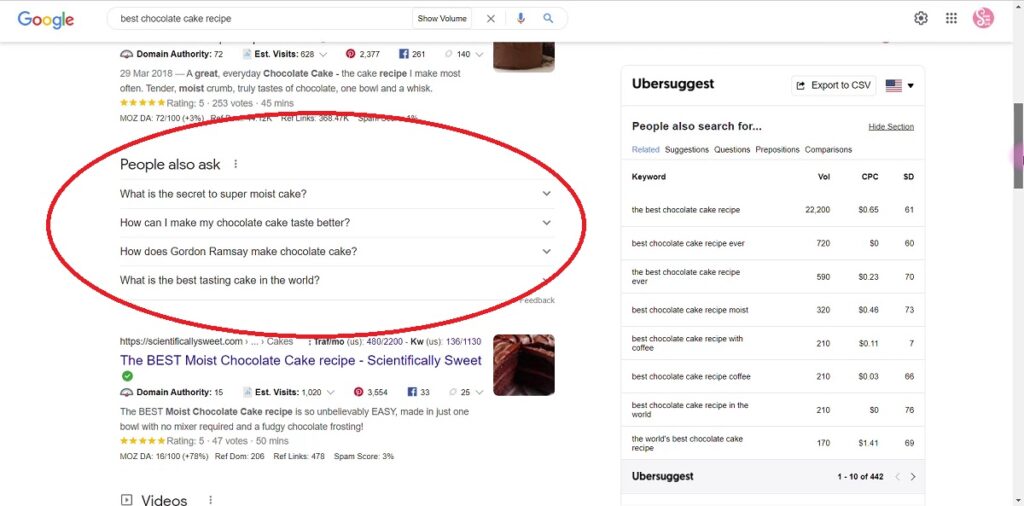
You will notice that on the right-hand side I have Ubersuggest installed as well. Neil Patel has some great advice for writing with good SEO content.
Debbie Gartner and SEO
My favorite SEO guru is Debbie Gartner. I have followed Debbie for a number of years and found her full of great advice. Debbie’s main blog is in the Home Decor niche and in the blogging world she is known as “The Flooring Girl”. In general, Debbie specializes in online marketing including blogging, blog coaching and styling, social media, email campaigns, Pinterest, and getting found online.
Debbie has a number of courses including a free one to get you started.
Her best blogging information on SEO for new bloggers is contained in her two e-books… Easy On-Page SEO and Debbie’s off-page SEO e-book Easy Backlinks for SEO. My recommendation would be to start with Easy On-Page SEO first and then Easy Backlinks. These two books can be purchased as a bundle too.
Debbie also has Google Analytics Easy as 1,2,3 affiliate to help those who are at the stage of monitoring Google Analytics, I know I am in there ALL the time!
Is SEO hard to learn?
Learning SEO can seem like a daunting task at first, with so much information on how the optimization process works and what search engines look for. This may seem overwhelming at first however work your way through as you grow your website. SEO will get easier and easier as you learn and become familiar with it. With both free information and paid courses, you will find your way around in no time at all.
Until next time,
Sue
Hooked On Blogging